

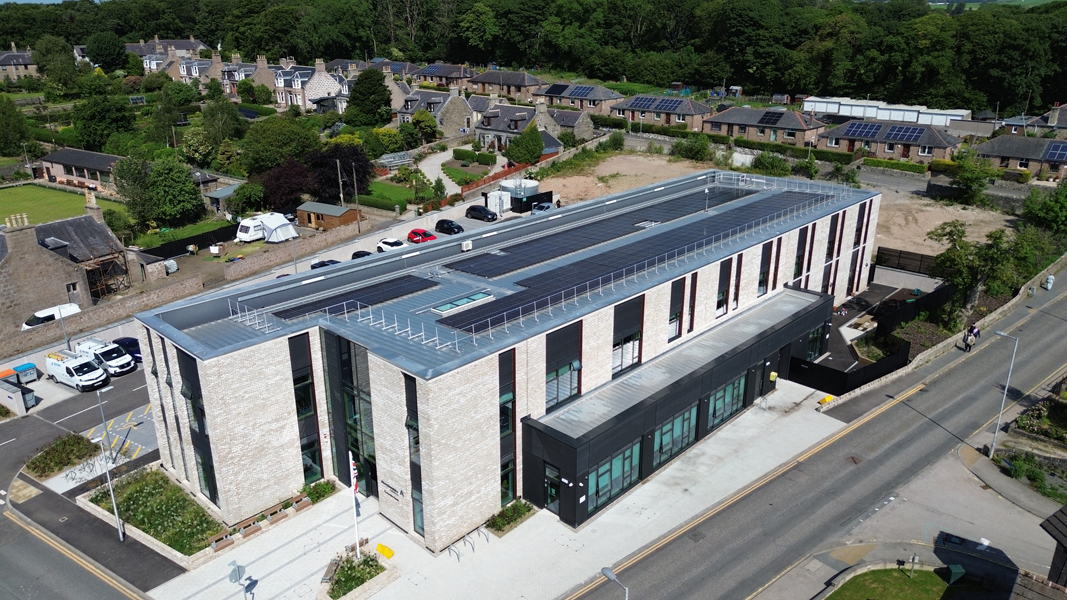
The construction of a new multi-purpose council building in the Aberdeenshire town of Ellon not only showcases successful development guided by circular economy principles, but also how technical collaboration in the supply chain makes an important contribution to achieving enhanced performance targets. Jon Knaggs, Technical Manager for Industrial Light Weight Construction at EJOT UK, explains why.
As local authorities across the UK adapt their approach to the development of new non-domestic buildings in line with carbon reduction targets, the circular economy is increasingly driving new design and build processes. This was key to the development of a new civic hub in the Aberdeenshire town of Ellon, which has enabled offices and community facilities to be combined into a single building
Opened in February 2025, this fully accessible two-storey building provides a family resource centre, library and other council facilities, including a ceremony room, registrar’s office, meeting room and an open plan office for 80 members of staff.
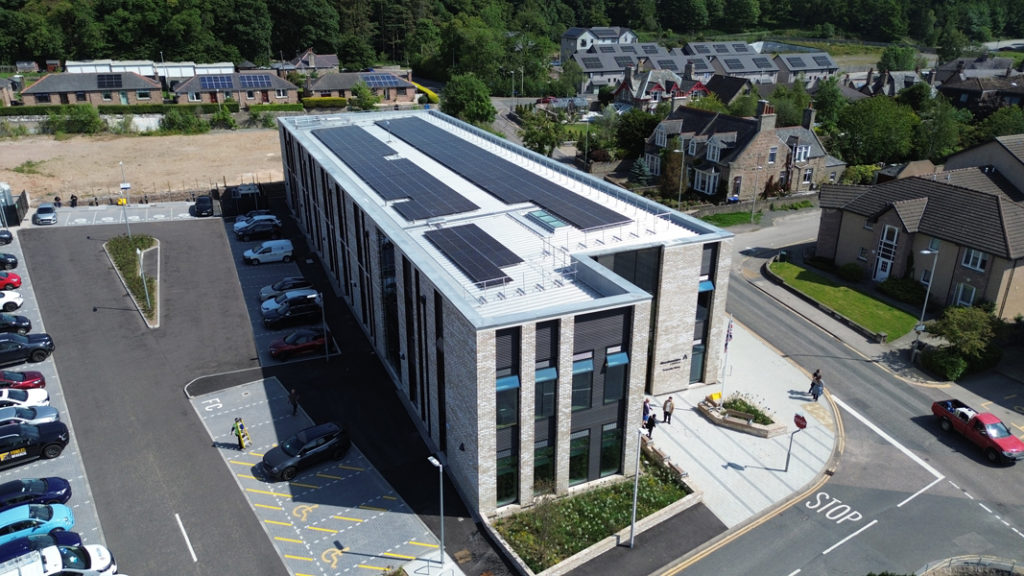
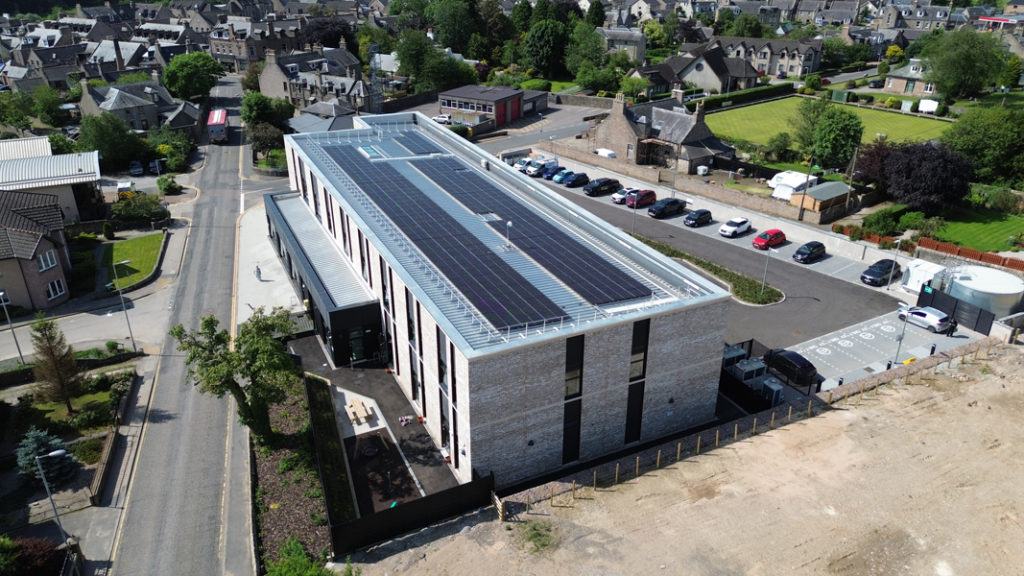
The building is designed to elevated sustainability standards with the aim of achieving net zero in operation. Renewable energy systems have been incorporated, principally photovoltaic panels (PV), heat pumps and a heat recovery ventilation system, and energy consumption for heating and cooling is minimised thanks to a highly insulated and airtight building envelope.
Externally, Formartine House has car parking with electric vehicle charging points, plus cycle lockers and stands to support sustainable transport. The landscaping scheme has preserved a 130-year old walnut tree and features planting to support pollinating insects, part of a broader strategy to support biodiversity which also includes ‘swift bricks’ and ‘bat bricks’ to allow for roosting within the building’s construction.
Circular economy driven design
Key to the planning and design process was the application of circular economy principles to support the council’s strategy to reduce carbon emissions on its path the net zero. By 2045, Aberdeenshire Council’s target is to reduce emissions (CO2e) levels resulting from its non-residential buildings by an estimated 53% from 2021 levels.
The architectural design and procurement teams collaborated with external organisations Zero Waste Scotland and Circular North-East early in the development process to build awareness of the circular economy and embed its principles. This resulted in the project adopting the idea of designing in layers to integrate a circular approach within each lifecycle element of the building.
Workshops were also held with the supply chain, including framework contractors and product suppliers, which helped to articulate the council’s aspirations and explore the possibilities to deliver the development in line with the circular economy.
Achieving a highly insulated envelope
Formartine House’s structure is formed of mass timber, principally CLT (cross-laminated timber) panels and glulam beams and columns. These materials were selected for a variety of reasons including their ability to provide flexibility with internal space planning, enabling the prefabrication of components and the potential for disassembly and future reuse thanks to the use of bolted connections.
The roof was formed using a Kalzip standing seam metal roof system incorporating thick insulation to minimise heat loss. One of the challenges associated with this area of the construction was ensuring the standing seam system could be securely fixed to the building’s glulam structure and supporting secondary steelwork.
And it was here that EJOT UK’s technical team were able to contribute after being consulted by roofing and cladding products distributor Tektum Supplies. They had been tasked by building envelope contractor Fowler McKenzie to develop a robust fixing specification.
How supply chain collaboration provided performance assurance
As sustainable building designs become more ambitious and combine materials in novel ways, it is crucial for specifiers, contractors and developers to have assurances that the proposed fastener and fixing approach for the building envelope will meet the performance goals.
The involvement of EJOT UK’s technical team in the construction of the roof for Formartine House provided the project team, including main contractor Morrison Construction, with access to a wealth of fastening systems knowledge and testing experience to arrive at a definitive fixing recommendation quickly and reliably.
The project illustrates how the optimum fastener specification can be developed through early collaboration amongst the building envelope supply chain partners, from the system manufacturer to the installer. And the recommendations were all backed by comprehensive test evidence of not only the fastener but also the substrates it is being used with.
Testing the concept
Testing is critically important because of the numerous variables, which could affect how well the fasteners perform, particularly in roof and façade designs utilising materials that are relatively recent entrants to mainstream construction.
After reviewing the proposed envelope design, as well as the specification of the substrates and the building structure, the EJOT team were able to recommend two types of EJOT JT3 fasteners. One of these FM Approved fasteners is purpose-designed for fixing standing seams and brackets and has been used on numerous projects throughout Europe and globally where Kalzip has been specified for many years.
Confirmation was provided that the performance of these fasteners would satisfy Kalzip’s technical criteria using calculations provided by Tektum, generated through their own unique prognosis software. The data yield enabled a range of detailed tests to be conducted by EJOT, including by recreating the application scenarios.
In addition to pullout tests, the material characteristics of the proposed envelope build-up were carefully assessed, including through an analysis of the steel section using used X-Ray Fluorescence (XRF) technology.
As part of a broad range of tests, withdrawal testing was also conducted on the glulam sections, which were conditioned in one of the dedicated chambers at EJOT UK’s testing and R&D facility, the Applitec Centre, for one week. Installation depth was also carefully monitored to further ensure quality control and consistency.
EJOT UK’s ability to be able to conduct comprehensive testing to internationally recognised provisions and provide the whole project team with reliable test evidence, meant specification decisions relating to the roof could be made with confidence at an early stage. This helped to reduce the potential for errors later in the build schedule and optimise long term performance.