Samantha Alleyne, Head of Business Development & Major Bids at Anglian Building Products, discusses why retrofit must be understood as a place-based strategy and calls for change in fragmented procurement strategies.
I welcomed the recent publication of the National Retrofit Hub insights paper: Health, Place & Retrofit: Findings and Recommendations for Change, as shared on LABM’s website here.
Here at Anglian Building Products, in collaboration with the National Maintenance Housing Forum (NHMF) Healthy Homes Working Group, we have been pushing this exact same argument that retrofit and healthy homes in general, must be understood as a place-based strategy with specification that considers individual homes and lives.
It is our opportunity as a sector to look holistically beyond improving SAP or Energy Ratings and seeing the works as just ‘building upgrades’, to achieve healthier, fit for purpose, truly sustainable homes and communities.
Place-based specification
The National Retrofit Hub quite rightly classes current definitions of retrofit as too narrow, a problem that starts right back at the point of specification. It’s only through changing specifications and frameworks for procurement that we can get better end results. Of course, retrofit must meet statutory obligations on emissions and fuel poverty alleviations, but it can do so much more.
Improvements can absolutely be made to the monitoring and measurement of retrofit measures at the end of the process, but we need to go right back to the beginning: how we procure solutions, and how we collaborate across the supply chain.
The sector’s current structures, packages of work, procurement routes, and specification processes, were never designed for the complexity of real homes or the lived realities of residents. If we want healthier homes, we need healthier systems.
Traditional packages of work are holding us back
Healthy and energy efficient homes are not just about bricks and mortar. They’re about how organisations think, act, and collaborate. It requires a cultural shift from viewing homes as collections of components to viewing them as environments that shape human wellbeing.
Take this simple example: A resident reports excess cold from a window with damp and mould in the same room, and a faulty window mechanism. That’s potentially three issues, three jobs, three teams — none of whom speak to each other — and three visits for the resident. The result? Disconnected fixes that fail to address the underlying problem and an unhappy resident.
This fragmentation is baked into the way work is packaged.
Most organisations still operate within familiar, siloed programmes:
- Window and door planned works
- Kitchen and bathroom programmes
- Whole‑house refurbishments
- Retrofit programmes
- Responsive repairs and maintenance
By the time procurement is complete, the opportunity for innovation in retrofit — new solutions and technology that can ease fuel poverty delivered by specialist door and window, damp and mould, renewable suppliers — has already passed.
If we want healthier homes, we need healthier specifications. Instead of relying on 20-year-old Decent Homes‑era templates or defaulting to Building Regulations, we should be designing scenario‑based, environment‑based specifications.
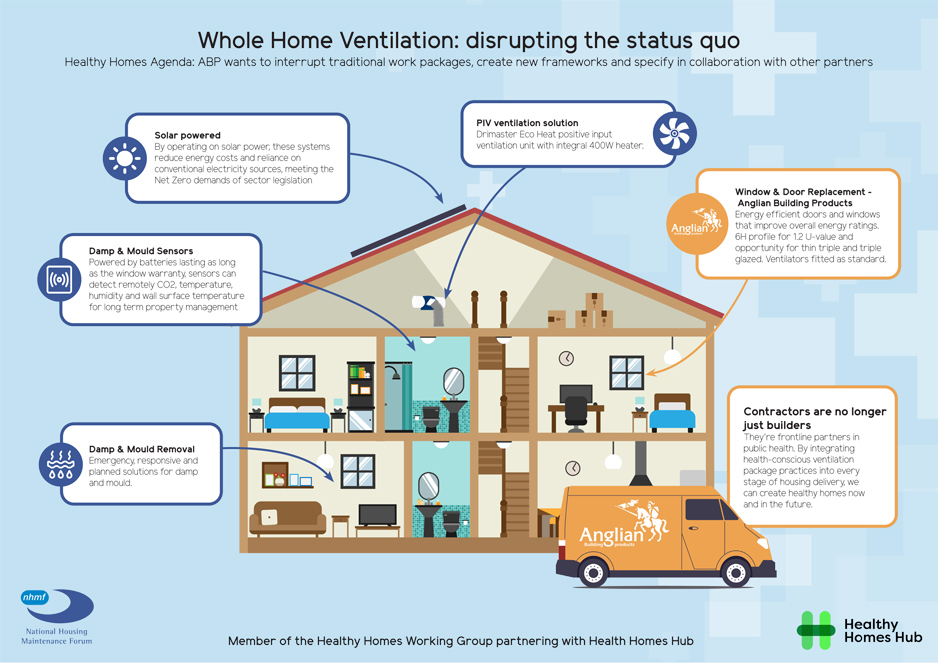
Consider windows. If we are replacing them anyway, why not:
- Fit sensors to monitor humidity or temperature?
- Conduct a damp and mould investigation?
- Review ventilation strategy holistically?
- Add solar panels while scaffolding is already in place?
These are not extravagant ideas, they are efficient, resident‑centred ones.
As the UK’s leading social housing door and window suppliers, we’ve seen just how central our products have become in tackling damp and mould and lived experience, impacting on warmth and comfort, ventilation and safety. We’ve seen how our role as contractors has become more front line in the battle for energy efficient, damp/ mould free homes.
We will continue to lobby and work with other liked minded organisations whist supporting communities to shape and assess outcomes, including through place-based approaches. We need to understand how homes are used in practice, how places differ, and how communities experience change. Our homes and communal buildings are the very foundation of good health and only then, does retrofit have the potential to be transformative.
Samantha was recently a speaker at the NHMF Conference Plenary: From Damp & Mould to Healthy Homes – Effective Interventions to find out more. Sam shared the stage in a session chaired by Tessa Barraclough (Assistant Director Asset Strategy and Sustainability, Riverside Group and Lead for NHMF’ Healthy Homes Working Group), Dale Holroyd, Co-Founder and Managing Director, ZapCarbon, Danny Bird, Interim Assistant Director of Regulated Delivery, Aster Group
To find out more, visit Anglian Building Products