

 With the Government committed to slash direct emissions from public sector buildings by at least 50% by 2032, and by 75% by 2037, compared to a 2017 baseline, the spotlight is firmly on public sector buildings. Heat pumps — as part of energy-efficient HVAC systems — have emerged as a cornerstone technology in this shift. Here, Harry Whitehead, Daikin UK’s Corporate Client’s Manager explains how and why.
Heating and cooling accounts for a significant proportion of emissions in public buildings. Traditional fossil fuel-based systems, predominantly gas boilers, contribute not only to operational carbon but also pose long-term exposure to fluctuating energy prices. In contrast, heat pumps, such as Daikin’s latest high temperature CZ-HT range, offer a low carbon alternative, providing heating and cooling much more efficiently. By replacing conventional systems with high-efficiency heat pumps, building owners can reduce running costs and drastically reduce operational carbon emissions, helping meet both legislative targets and organisational sustainability goals.
Selecting the right system requires careful consideration, balancing building design, energy demand profiles, and operational priorities. Air-to-water heat pumps, for instance, can integrate with existing systems, enabling a phased transition that minimises disruption while maximising efficiency. Similarly, air-to-air heat pumps, including Daikin’s VRV systems, offer flexibility for retrofits in buildings where ductwork or pipework modifications would be prohibitively expensive.
The technology itself has matured considerably, delivering higher coefficient-of-performance values than ever before, meaning more heat is delivered per unit of electricity consumed, a crucial factor when public sector budgets are under scrutiny.
Refrigerant choice
Another key element in the decarbonisation strategy is refrigerant choice. The shift from high-global-warming-potential (GWP) refrigerants, such as R-410A, to lower-GWP alternatives like R-32 has a direct impact on both operational and embodied carbon. R-32 systems are not only compliant with increasingly stringent legislation but also offer practical advantages, including improved energy efficiency and a lower refrigerant charge. For public buildings, where lifecycle costs and regulatory compliance are closely monitored, this combination of environmental and operational benefits is especially compelling.
Decarbonising public buildings also requires transparency and accountability across the supply chain. Facilities managers and procurement teams in both the public and private sectors increasingly rely on Environmental Product Declarations (EPDs) to understand the full lifecycle carbon impact of HVAC systems. These independently verified documents provide standardised data on embodied carbon, from raw material extraction and manufacturing to transportation and installation.
Combined with operational carbon metrics, they allow public sector organisations to make informed decisions, optimise total lifecycle performance, and demonstrate compliance with frameworks such as BREEAM, NABERS, and the UK Net Zero Carbon Buildings Standard.
Monitoring, maintenance and optimisation
Implementation is only part of the equation. Continuous monitoring, maintenance, and optimisation ensure that heat pumps operate at peak efficiency throughout their lifespan. Smart controls, integration with building management systems, and predictive analytics allow local authorities to adjust operations across their building stock in real time, reducing energy consumption and carbon output whilst minimising running costs. In this way, decarbonisation is not a single step forwards but a long-term, data-driven strategy.
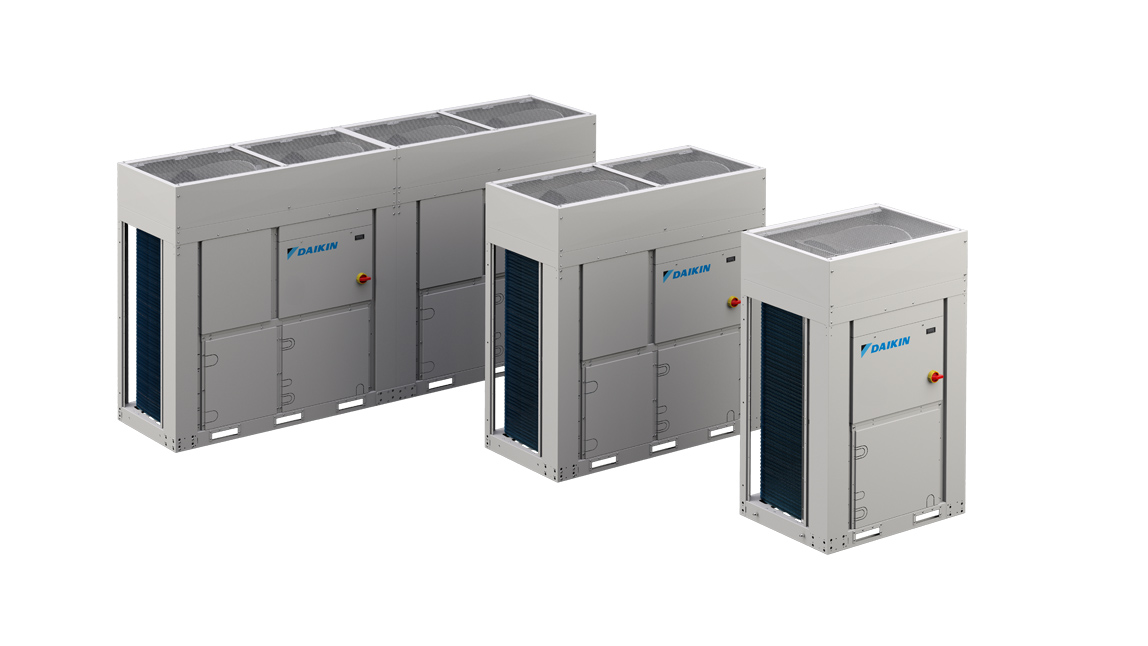 The benefits of this approach are clear — reduced emissions, lower energy costs, compliance with evolving regulations, and improved resilience of public assets. As the UK accelerates towards net zero, public buildings can serve as exemplars of sustainable transformation, showing how investment in low carbon technologies delivers measurable environmental and financial returns. Heat pumps, supported by the right refrigerants — such as Daikin’s R-32 and upcoming CO2 options — together with cloud solutions such as Daikin Cloud Plus, and supply chain transparency, are central to achieving this vision.
Daikin recognises that the transition to net zero is complex and requires more than incremental change. It demands a coordinated approach encompassing technology, regulation, and operational insight. Through the adoption of energy-efficient heat pumps and sustainable refrigerants like R-32, public buildings can reduce their environmental footprint, meet compliance requirements, reduce running costs and provide long-term value. The road to net zero is challenging, but with the right tools, expertise, commitment and decarbonisation solutions, public sector organisations can lead the way, turning ambition into action.
To find out more about how Daikin can help your local authority decarbonise it’s heating and cooling, visit www.daikin.co.uk/cz-ht