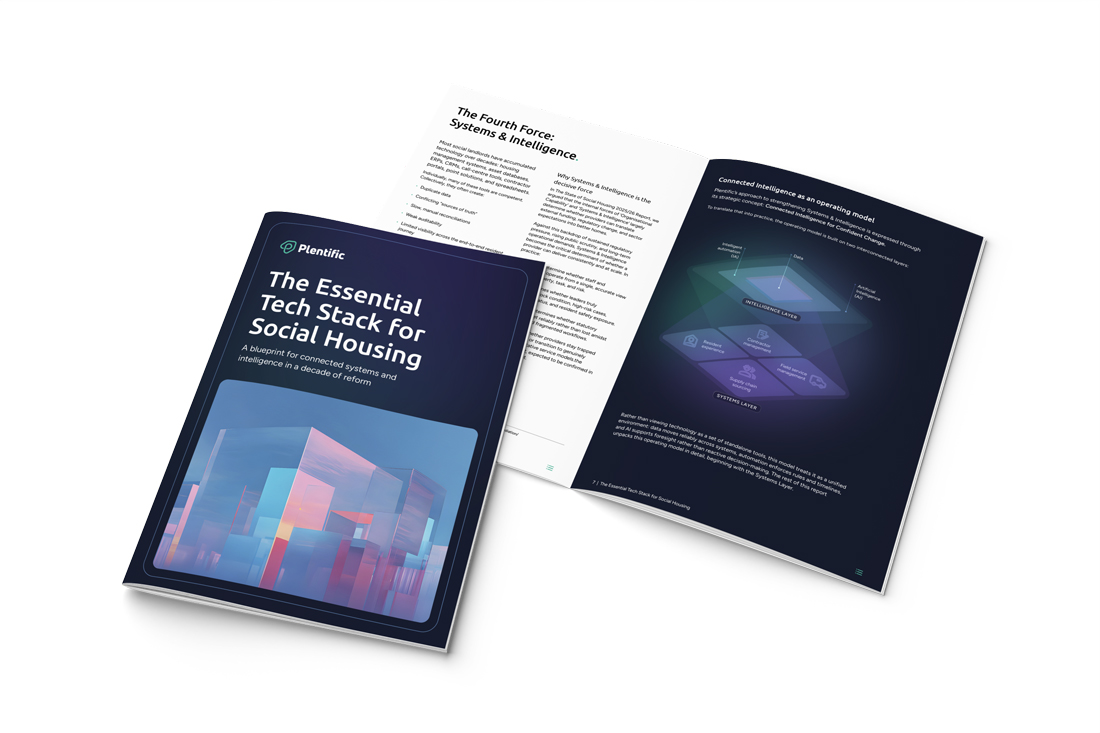
Technology leader Plentific has launched its blueprint for connected systems and intelligent operations in a decade of reform for the UK social housing sector.
The Essential Tech Stack for Social Housing builds on Plentific’s State of Social Housing 2025/6 Report and the Four Forces Framework discussed in it, focusing on the fourth force, Systems and Intelligence.
This force is emerging as the bridge to support the social housing sector’s aspirations, underpinning and enabling the navigation of every other area in the framework, from governance improvement to organisational capability and long-term investment planning.
The sector is at a turning point, a crossroads where a shift from manual, reactive service delivery to systems-led, data-driven operations is required, taking a proactive approach capable of meeting rising resident expectations with consistency.
Housing providers are being downgraded because their systems, records and controls do not accurately reflect the state of their properties. In its Repairing Trust Report, the Housing Ombudsman highlighted that most persistent service failures; including damp and mould, delays to repairs, inaccuracies in case handling and breakdowns in compliant escalation, stem from weaknesses in data and information.
The right technology stack is a critical resource multiplier enabling housing providers to scale service delivery and ensure regulatory adherence without overloading teams.
Multi-award winning Plentific’s approach to strengthening Systems and Intelligence is built on interconnected layers. Rather than viewing technology as standalone tools, Plentific’s operating model is a unified environment, a digital ecosystem with accurate data flowing reliably across system layers, enhancing the resident experience and performance levels for contractor management, supply chain sourcing and field service management.
Facing fragmented workflows, Plentific’s intelligence layer comprises structured, real-time data, intelligent automation which determines whether statutory timelines are met and AI supporting foresight and genuinely proactive, preventative service models rather than reactive decision making.
Cem Savas, CEO of Plentific, said: “Over the next decade, there will be a widening operational divide between providers who can deliver at scale, to a consistent standard that meets regulatory and public scrutiny and those who struggle under compounded regulatory and service pressures, falling behind on core duties, despite the best efforts of their teams.
“Social landlords’ ability to continuously provide safe and decent homes, maintain accurate records, demonstrate clear governance and communicate effectively with residents will depend entirely on whether their systems, data and intelligence capabilities are fit for purpose.
“Ultimately, the decisive force shaping which providers keep pace and which are left behind will be the extent of tech implementation and adoption across the organisation. Technology, specifically the combination of systems, data, automation and AI, is no longer the backoffice support function it once was. It is the foundation that enables compliant, predictable, outcome focused housing services.”
The Essential Tech Stack for Social Housing guide offers a practical, evidence-based framework for building operational foundations with technology at the centre, providing insights to future-proof social landlords.
Designed around connected systems, real-time data and integrated intelligence, it enables early action and consistent response, demonstrating compliance with confidence.